Trail Log

Notes from the field. Conditions, incidents, observations. Not reviews. Not poetry.

Kumano Kodo|June 2026

Rain on the Kodo

Mud, leeches, and why it is still worth it
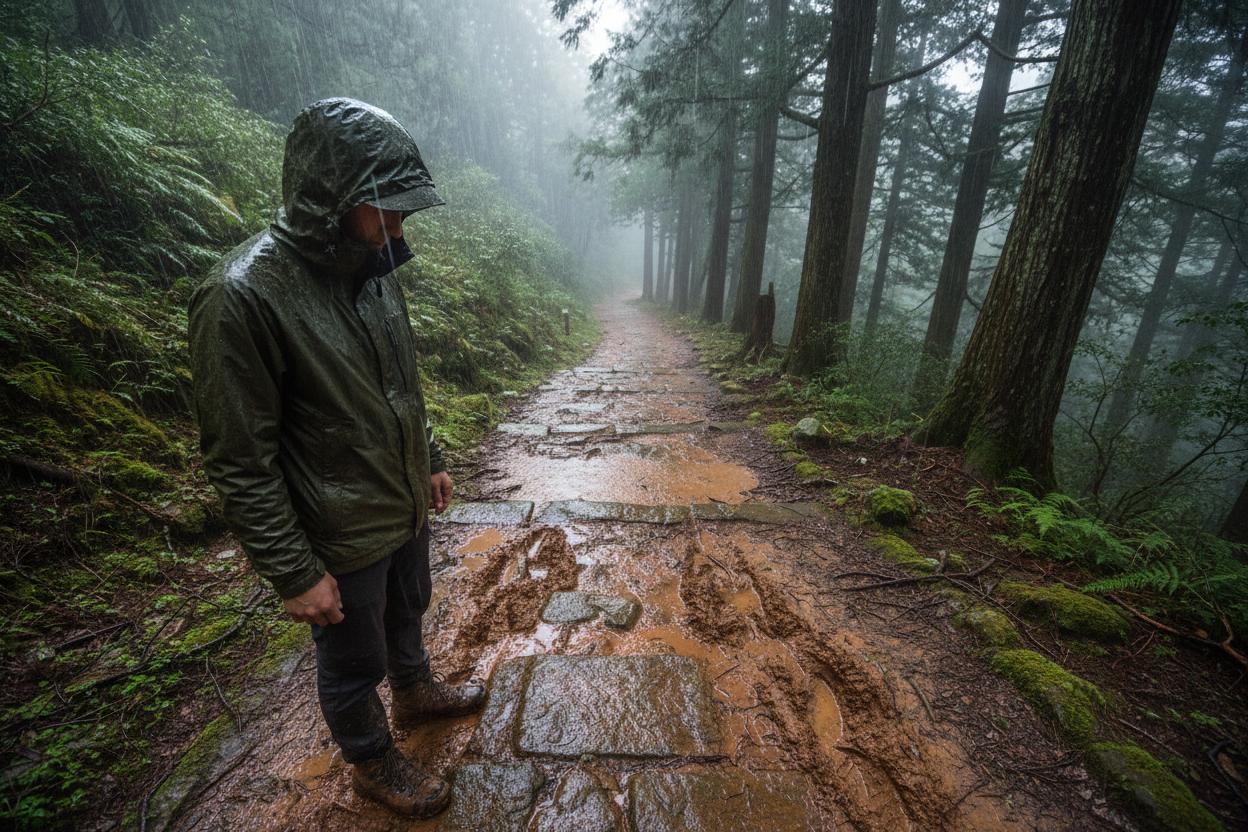
Hiker walking through rain on muddy Kumano Kodo trail

Day two. It started raining at 6am and did not stop until 4pm. Nine hours. The stone steps on the Kodo are worn smooth by a thousand years of pilgrims and in this kind of rain they become a surface you cannot trust. Three of us slipped. One bruised a hip. Nothing serious, but it slowed us down.

The leeches came out after hour three. They are small, black, and persistent. Leech socks stopped most of them but two got through. You do not feel the bite. You just notice the blood later. This is normal on the Kodo in June. We checked each other at breaks.

Here is the thing: the moss on the trees and rocks takes on a color in heavy rain that does not exist in dry conditions. It is greener. The kind of green that makes you understand why this place is sacred. The shrine gates look older when wet. Everything smells of cedar and damp earth.

The family lodge that night had a wood-fired bath. We sat in it for an hour without speaking. The owner brought us mountain vegetables and grilled river fish. The rain hammered the roof. I have done this trek fourteen times and the rainy ones are the ones I remember.

Bring waterproof boots with good tread. Bring leech socks. Bring a sense of humor. The Kodo is not a trail you conquer. It is a trail you walk through, whatever the conditions.

Northern Alps|August 2026

Hotaka Ladder

10 meters of vertical steel. Not as scary as it looks.

The ladder on Hotaka is 10 meters of vertical steel bolted directly into the granite face. Two hands required at all times. There is a chain for clipping a lanyard if you want the security. Most people do, the first time.

I have guided this section over 80 times. The fear is always worst before you start. Standing at the base looking up, your brain does the math on the exposure. 800 meters of air below the lowest rung. But the ladder itself is solid. The bolts were checked last season. The steel has no corrosion.

The trick: do not look down until you clip into the anchor at the top. Focus on the rungs. One at a time. By rung four, your body takes over. By rung eight, you are almost enjoying it. Then you clip in, turn around, and look down. That view is why you came.

In wet conditions, we rope up and belay. The ladder is closed in heavy rain or icing. We check the forecast obsessively. If there is any doubt, we take the alternative route via the col. It adds two hours but there is no shame in the safe option.

Last week, a client in her 60s did it on her second try. She froze at rung three, breathed for thirty seconds, then kept going. At the top she laughed and said it was better than therapy. This is why I do this job.

Mt. Fuji Off-Season|November 2026

Fuji at 3am

Minus 15, wind 80km/h. The summit is not the point.

We left the 8th station hut at 2:30am. The thermometer on the hut wall read minus 12 degrees Celsius. The wind was already gusting to 60 km/h. By the time we reached the summit ridge, it was minus 15 and the wind had picked up to 80.

This is not hiking. This is mountaineering. Crampons on hard blue ice. Ice axe in the uphill hand. Every step is a deliberate placement. The wind tries to knock you off balance. You lean into it. Your goggles fog and freeze. You wipe them, they fog again.

One client turned back at 3,200m. She made the right call. Altitude hit her harder than expected combined with the cold. The guide went down with her. The rest of us continued as a rope team of three.

The sunrise at the summit was not pretty. It was functional. Light returned, the wind dropped slightly, and we could see the shadow of Fuji cast across the cloud layer below. That is the moment. Not a photo. The realization that you are standing on the highest point in Japan in winter conditions and you earned it.

Descent took four hours. The snow softened and the crampons came off at 3,000m. By the 5th station, the sun was warm and we were eating vending machine ice cream in down jackets. Fuji does that to you.

Hokkaido|September 2026

Bear Bell Etiquette

When to ring, when not to, what bears actually do

We carry bear bells on Daisetsuzan. Not because bears are a constant threat, but because the consequences of a surprise encounter are severe. Brown bears in Hokkaido are not the small black bears of Honshu. They are big, they are unpredictable, and they have cubs in early summer.

The etiquette: ring the bell when visibility is low (fog, dense vegetation, stream crossings). Do not ring constantly on open ridgelines where bears can see you from a distance. The goal is to avoid surprise, not to annoy every animal in a half-kilometer radius.

In 15 seasons of guiding in Hokkaido, I have seen bears 4 times. Three times, the bear saw us first and was already moving away. Once, a young bear stood up to watch us pass. We backed up slowly, spoke calmly, and it lost interest. No bells were rung that time. The bear knew we were there.

Bear spray is a last resort. We carry two cans per group. The safety clip stays on unless a bear is charging. A charging bear is extremely rare. Most encounters end with both parties walking in opposite directions.

The real danger on Daisetsuzan is not bears. It is the weather changing in 20 minutes, the loose volcanic rock, and the fog that drops visibility to 10 meters. The bells are for bears. Your map, compass, and guide are for everything else.